When it comes to forex trading, there is a plethora of options available to you. Of these options, binary options trading has become quite popular among investors in recent years, because of the low level of investment needed and the potential to score higher profits is there. As such, this realm of forex trading is particularly useful for novices who are just getting started in this investment practice and want a little more experience and knowledge building before dumping larger amounts of your money into forex accounts.
Unlike traditional models of investing, such as purchasing stocks or bonds, binary options are contracts in which your income relies on the direction of the given asset within a certain time frame. This is known as a less-risky option in forex trading, as you, the investor, get the same set income regardless of how much the value rises in the contract. The only thing that matters in binary options forex trading is that you were correct in your predictions.
To simplify matters even more, there are just two options in binary forex trading that you need to be concerned about: put options and call options. A put option is an investment made when you believe the price of the contract will be below the original price upon expiration. Meanwhile, a call option is the exact opposite, with you expecting the overall price to rise above the original value upon the expiration date.
This can easily be applied to forex trading. For example, if economic indicators are looking bad for the European Union, you could purchase a put option on a Euros contract, with the expectation of the currency’s value to drop by the time your contract is up. Likewise, if the value of the US dollar looks like it could be rising in the near future, the best way to capitalize on this while minimizing personal risk would be to purchase a call option on the USD and profit when the value does in fact, go up. Your leverage would not be as high as, say, a traditional forex trader relying on the currency’s consistent value and no set asset ceiling to be gained (or lost). However, binary options are essentially one of the safest bets you can make as a forex trader.
In a highly volatile market such as forex trading, it’s quite beneficial for newer or small-time investors to have the binary options available in order to minimize the risk on their investments. This allows them to learn the ropes of forex market practices and learn to read forex trading signals without suffering heavy losses along the way. It has all of the same currency pair mechanisms of traditional forex trading, but with smaller caps and less risk factor.
This article was written by Will from Forex Trading Finder. Visit Forex Trading Finder for more information on Binary Options Trading.
Related posts:
Binary Option Versus Forex Trading: When One is More Favorable Than the OtherDid you see these options trading secrets videos?Top 3 Forex Trading TipsStocks versus FOREX TradingFREE Video: The Options Trading Manifesto – A Tale of Two Traders
View the original article here
Wednesday, 2 November 2011

Aussie Dollar in a Copper Cauldron!
by Jack Crooks

I keep thinking that any day now the Australian dollar will take a dirt nap. It took one back in mid-2008, falling a stunning 39 percent in just three months in the midst of the credit crunch. This shows just how vulnerable the Aussie can be to a growth accident that slams the world economy; it is the premiere risk currency among the major dollar currency pairs.
Global growth is fading fast again, and copper seems to be highlighting that story. It could be lights out for the Aussie again if that’s the case.
As you can see in the chart below, the copper futures weekly uptrend line is broken, and the primary trend is down. The yellow rectangular box shows what happened in the midst of the great credit crunch of 2008.

And as you may know, copper is considered a key industrial metal; its price movement is often used as an indicator of the direction of growth in the global economy.
If you are a regular reader of Money and Markets, you likely know that China is the world’s largest consumer of copper. But the drop in prices has not come as a welcome development. This is because …
Copper Has Taken on an
Important Role in Financing
An increasing number of Chinese firms have been stockpiling the metal and using it as collateral — because the government’s measures to curb inflation have limited the firms’ access to credit. Such financing links the price of copper to other key elements of the Chinese economy, including the growing speculative real estate bubble.
China’s tightening monetary policy has made it more difficult to access credit through official channels. As a result, Chinese small- and medium-size enterprises have increasingly turned to copper for use as collateral in loans, which are then funneled into other sectors of the economy.
The falling price of copper means that the collateral initially put up for the loans in yuan is no longer worth what it once was, decreasing the likelihood that the borrower will be able to pay back the loan.
If firms default on debts, then others connected in the chain will default — and determining where loans have been invested is nearly impossible.
Banks and state-owned enterprises (SOEs) are also potentially vulnerable. A high number of SOEs have also used copper as collateral. These firms are often involved in the real estate sector — even if their primary function is not always directly linked to it — and are therefore exposed to the country’s growing real estate bubble.
The government would bail out the more politically favored SOEs if necessary. But that would leave fewer resources to be allocated to the private sector, which is crucially important to China’s growth.
It is all about feedback loops. And …
This One Could Turn Quite Vicious
for China and In Turn the Aussie Dollar!
The Australian economy is highly dependent on China for its own growth. For a while now, I’ve been saying that Australia has effectively become a satellite country of China. Take a look at this chart showing China’s imports from Australia thru September.
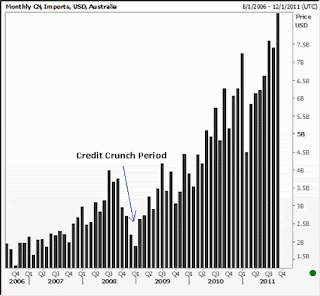
Lower copper prices could put a real damper on Australia’s growth. Another major hit is already in play: Falling consumer demand from the euro zone and the U.S.
And if the bubble were to finally pop in Chinese real estate, it would be much uglier indeed.
So we have the potential for real demand in copper and other commodities to decline sharply. Toss in the added thumping from the internal Chinese speculation, which would likely push the metal back toward its credit crunch low, and you get another 50 percent decline in the red metal.
And guess which currency has been tightly correlated to the price of copper over the last few years? If you said the Aussie dollar, you were right on!
There are two key takeaways from the following chart of the Aussie/U.S. dollar vs. copper:
1) There is a very large divergence between the two price series; and
2) In the past the series have been highly correlated.

I suspect we will see a big move one way or the other. It could be copper soars. But for now, I’m betting the Aussie tanks.
Stay tuned.
Jack
Related posts:
Stronger yuan, higher labor costs, euro zone threaten China’s advantageCanadian Dollar – The Ultra-Safe Secret Natural Gas PlayTaps for the DollarDollar Sharply Lower on China Reserve Diversification TalkPlaying the China Blame Game – The Currencies to Trade if the U.S. Launches Another Trade War
.
View the original article here
I keep thinking that any day now the Australian dollar will take a dirt nap. It took one back in mid-2008, falling a stunning 39 percent in just three months in the midst of the credit crunch. This shows just how vulnerable the Aussie can be to a growth accident that slams the world economy; it is the premiere risk currency among the major dollar currency pairs.
Global growth is fading fast again, and copper seems to be highlighting that story. It could be lights out for the Aussie again if that’s the case.
As you can see in the chart below, the copper futures weekly uptrend line is broken, and the primary trend is down. The yellow rectangular box shows what happened in the midst of the great credit crunch of 2008.

And as you may know, copper is considered a key industrial metal; its price movement is often used as an indicator of the direction of growth in the global economy.
If you are a regular reader of Money and Markets, you likely know that China is the world’s largest consumer of copper. But the drop in prices has not come as a welcome development. This is because …
Copper Has Taken on an
Important Role in Financing
An increasing number of Chinese firms have been stockpiling the metal and using it as collateral — because the government’s measures to curb inflation have limited the firms’ access to credit. Such financing links the price of copper to other key elements of the Chinese economy, including the growing speculative real estate bubble.
China’s tightening monetary policy has made it more difficult to access credit through official channels. As a result, Chinese small- and medium-size enterprises have increasingly turned to copper for use as collateral in loans, which are then funneled into other sectors of the economy.
The falling price of copper means that the collateral initially put up for the loans in yuan is no longer worth what it once was, decreasing the likelihood that the borrower will be able to pay back the loan.
If firms default on debts, then others connected in the chain will default — and determining where loans have been invested is nearly impossible.
Banks and state-owned enterprises (SOEs) are also potentially vulnerable. A high number of SOEs have also used copper as collateral. These firms are often involved in the real estate sector — even if their primary function is not always directly linked to it — and are therefore exposed to the country’s growing real estate bubble.
The government would bail out the more politically favored SOEs if necessary. But that would leave fewer resources to be allocated to the private sector, which is crucially important to China’s growth.
It is all about feedback loops. And …
This One Could Turn Quite Vicious
for China and In Turn the Aussie Dollar!
The Australian economy is highly dependent on China for its own growth. For a while now, I’ve been saying that Australia has effectively become a satellite country of China. Take a look at this chart showing China’s imports from Australia thru September.

Lower copper prices could put a real damper on Australia’s growth. Another major hit is already in play: Falling consumer demand from the euro zone and the U.S.
And if the bubble were to finally pop in Chinese real estate, it would be much uglier indeed.
So we have the potential for real demand in copper and other commodities to decline sharply. Toss in the added thumping from the internal Chinese speculation, which would likely push the metal back toward its credit crunch low, and you get another 50 percent decline in the red metal.
And guess which currency has been tightly correlated to the price of copper over the last few years? If you said the Aussie dollar, you were right on!
There are two key takeaways from the following chart of the Aussie/U.S. dollar vs. copper:
1) There is a very large divergence between the two price series; and
2) In the past the series have been highly correlated.

I suspect we will see a big move one way or the other. It could be copper soars. But for now, I’m betting the Aussie tanks.
Stay tuned.
Jack
Related posts:
Stronger yuan, higher labor costs, euro zone threaten China’s advantageCanadian Dollar – The Ultra-Safe Secret Natural Gas PlayTaps for the DollarDollar Sharply Lower on China Reserve Diversification TalkPlaying the China Blame Game – The Currencies to Trade if the U.S. Launches Another Trade War
.
View the original article here
Tuesday, 1 November 2011
Stronger yuan, higher labor costs, euro zone threaten China’s advantage
by Jack Crooks
Saturday, October 29, 2011 at 7:30am

Bank of Canada governor Mark Carney said the euro-zone crisis poses the biggest risk to Canada’s economy; and it could take years to fully play out.
But that’s one reason why he just announced the BOC has lowered the growth targets from 2.8 percent to 2.1 percent in 2011 and from 2.6 percent to 1.9 percent in 2012. Another big part of the downward revisions was the decline in exports due to a stronger Canadian dollar.

Obviously then, currency valuations make a huge difference!
Speaking of rising currency valuations dragging down a country’s growth, there’s another story in the background of all this euro-zone crisis chaos … China.
China’s economy isn’t exactly looking good.
I saw an article headline yesterday that suggested a Chinese hard landing is merely a tail risk — something that is highly unlikely to occur but would bring about many unforeseen consequences should it happen.
Nevertheless, to help you track the slowdown path China will be taking …
We could point you to STRATFOR’s founder George Friedman’s book, The Next 100 Years. You’ll get a good sense of how geopolitical and global economics will impact China in the years ahead.
Or we could steer you to comments from The Boston Consulting Group’s latest report: Made in America, Again! It highlights the expected renaissance in U.S. manufacturing, noting the impact it will have on China’s heretofore advantage in manufacturing.
While we may have seen imports of refined copper surge to 16-month highs in September and the HSBC China Manufacturing Purchasing Managers Index expand after 3 consecutive down months, China is fighting a need to become less dependent on manufacturing to feed export demand.
Not only are the tides shifting between the U.S. and China, but the recent currency appreciation is hampering China’s advantage elsewhere. Check out this chart of the Chinese yuan versus the Indian rupee:

Clearly a break out!
Of course, this is not all to do with the yuan; the rupee has fallen in value recently amidst a monetary policy shift. But China still must face head-on, from several angles, its narrowing currency advantage.
Bank of Canada Governor Carney also noted that the monetary policy in the U.S. is one of the leading causes for appreciation of the Canadian dollar.
Ben Bernanke exports U.S. monetary policy to China. And its currency is mostly pegged to the dollar. Therefore, China has been forced to decide between inflation-led growth and a reduction in export competitiveness.
Thus, inflation rules the day. Only now are officials considering abandoning a tight monetary policy that aimed to suppress credit growth and avoid a bursting bubble.
Naturally, amidst this inflation, Chinese wage growth is beginning to eat away at the competitive trade advantage for which China has become known over the last decade. This is from The Boston Consulting Group’s report:
Wage and benefit increases of 15 to 20 percent per year at the average Chinese factory will slash China’s labor-cost advantage over low-cost states in the U.S., from 55 percent today to 39 percent in 2015, when adjusted for the higher productivity of U.S. workers. Because labor accounts for a small portion of a product’s manufacturing costs, the savings gained from outsourcing to China will drop to single digits for many products.For many goods, when transportation, duties, supply chain risks, industrial real estate, and other costs are fully accounted for, the cost of savings of manufacturing in China rather than in some U.S. states will become minimal within the next five years.
We are already seeing pushback in the United States to policies that have favored off-shoring and enabled trade imbalances. As the market works itself out — inside the guiderails of U.S. monetary policy and away from the shifting landscape in Asia — China will find itself inching closer and closer to that tail risk.
What’s more, as with Canada, the major hit that’s bound to shred the euro zone’s growth to smithereens is going to bog down China.
Now I’d be crazy to suggest euro-zone officials have found a way out of crisis mode …
The European crisis summit didn’t even come close to producing a definitive solution to the Continent’s debt nightmare.
Banks agreed to taking a 50 percent loss on the Greek debt they own and also to raise new capital …
But no action was taken to protect the banks from far larger losses on Spanish and Italian debt.
There was no plan for enlarging the Euro bailout fund — essential for raising the cash that will be needed to save other PIIGS nations.
At best they’ve simply gotten the squabbling out of the way with investor pessimism backing off for the time being. And that means many eyes could turn to the details of China’s slowdown.
So Chinese officials have their work cut out for them. The most they can hope for is a slow deterioration in investor sentiment. Or else the tail risk begins to wag …
And we know what happens if the new “lynchpin” of the global economy shakes loose.
Best wishes,
Jack
Related posts:
China Knows the Fate of the EuroPlaying the China Blame Game – The Currencies to Trade if the U.S. Launches Another Trade WarGlobal Trade and the YuanEuro-zone PMI Reflects Slowing Manufacturing, Services SectorsThe Falling Euro May Offer the Best Investment Opportunity in 2011
View the original article here
Saturday, October 29, 2011 at 7:30am
Bank of Canada governor Mark Carney said the euro-zone crisis poses the biggest risk to Canada’s economy; and it could take years to fully play out.
But that’s one reason why he just announced the BOC has lowered the growth targets from 2.8 percent to 2.1 percent in 2011 and from 2.6 percent to 1.9 percent in 2012. Another big part of the downward revisions was the decline in exports due to a stronger Canadian dollar.

Obviously then, currency valuations make a huge difference!
Speaking of rising currency valuations dragging down a country’s growth, there’s another story in the background of all this euro-zone crisis chaos … China.
China’s economy isn’t exactly looking good.
I saw an article headline yesterday that suggested a Chinese hard landing is merely a tail risk — something that is highly unlikely to occur but would bring about many unforeseen consequences should it happen.
Nevertheless, to help you track the slowdown path China will be taking …
We could point you to STRATFOR’s founder George Friedman’s book, The Next 100 Years. You’ll get a good sense of how geopolitical and global economics will impact China in the years ahead.
Or we could steer you to comments from The Boston Consulting Group’s latest report: Made in America, Again! It highlights the expected renaissance in U.S. manufacturing, noting the impact it will have on China’s heretofore advantage in manufacturing.
While we may have seen imports of refined copper surge to 16-month highs in September and the HSBC China Manufacturing Purchasing Managers Index expand after 3 consecutive down months, China is fighting a need to become less dependent on manufacturing to feed export demand.
Not only are the tides shifting between the U.S. and China, but the recent currency appreciation is hampering China’s advantage elsewhere. Check out this chart of the Chinese yuan versus the Indian rupee:

Clearly a break out!
Of course, this is not all to do with the yuan; the rupee has fallen in value recently amidst a monetary policy shift. But China still must face head-on, from several angles, its narrowing currency advantage.
Bank of Canada Governor Carney also noted that the monetary policy in the U.S. is one of the leading causes for appreciation of the Canadian dollar.
Ben Bernanke exports U.S. monetary policy to China. And its currency is mostly pegged to the dollar. Therefore, China has been forced to decide between inflation-led growth and a reduction in export competitiveness.
Thus, inflation rules the day. Only now are officials considering abandoning a tight monetary policy that aimed to suppress credit growth and avoid a bursting bubble.
Naturally, amidst this inflation, Chinese wage growth is beginning to eat away at the competitive trade advantage for which China has become known over the last decade. This is from The Boston Consulting Group’s report:
Wage and benefit increases of 15 to 20 percent per year at the average Chinese factory will slash China’s labor-cost advantage over low-cost states in the U.S., from 55 percent today to 39 percent in 2015, when adjusted for the higher productivity of U.S. workers. Because labor accounts for a small portion of a product’s manufacturing costs, the savings gained from outsourcing to China will drop to single digits for many products.For many goods, when transportation, duties, supply chain risks, industrial real estate, and other costs are fully accounted for, the cost of savings of manufacturing in China rather than in some U.S. states will become minimal within the next five years.
We are already seeing pushback in the United States to policies that have favored off-shoring and enabled trade imbalances. As the market works itself out — inside the guiderails of U.S. monetary policy and away from the shifting landscape in Asia — China will find itself inching closer and closer to that tail risk.
What’s more, as with Canada, the major hit that’s bound to shred the euro zone’s growth to smithereens is going to bog down China.
Now I’d be crazy to suggest euro-zone officials have found a way out of crisis mode …
The European crisis summit didn’t even come close to producing a definitive solution to the Continent’s debt nightmare.
Banks agreed to taking a 50 percent loss on the Greek debt they own and also to raise new capital …
But no action was taken to protect the banks from far larger losses on Spanish and Italian debt.
There was no plan for enlarging the Euro bailout fund — essential for raising the cash that will be needed to save other PIIGS nations.
At best they’ve simply gotten the squabbling out of the way with investor pessimism backing off for the time being. And that means many eyes could turn to the details of China’s slowdown.
So Chinese officials have their work cut out for them. The most they can hope for is a slow deterioration in investor sentiment. Or else the tail risk begins to wag …
And we know what happens if the new “lynchpin” of the global economy shakes loose.
Best wishes,
Jack
Related posts:
China Knows the Fate of the EuroPlaying the China Blame Game – The Currencies to Trade if the U.S. Launches Another Trade WarGlobal Trade and the YuanEuro-zone PMI Reflects Slowing Manufacturing, Services SectorsThe Falling Euro May Offer the Best Investment Opportunity in 2011
View the original article here
Global Trade and the Yuan

As a general rule the most successful man in life is the man who has the best information
“How soon will the Chinese natural resource demand decrease? The Chinese population is significantly larger than every individual country’s population in the world (except India).” Is China the New North? Assessing the Impact of Chinese Trade with Latin America, Brookings Institution
“In terms of long-term structural trends, demand is now driven by an urbanization process that is far more structural than consensus generally believes. On our analysis, China is only 20 to 25 per cent along the path towards being a mature materials market and it may take at least six to nine years before demand intensity peaks.” Andrew Keen, Thorsten Zimmermann and Lourina Pretorius, analysts at HSBC
BCG Consulting says China is expected to become the world’s second largest consumer market by 2015 and by 2020 China’s consumer consumption nation-wide will amount to 22 percent of total global consumption, behind only the U.S. at 35 percent. The expected transition from an investment led economy to a more consumer focused model will bring about continued growth.
The McKinsey Global Institute projects that India’s middle class will grow to 583 million people in the next two decades. At the same time, the country will advance from the world’s 12th largest consumer market to the fifth largest.
Africans, on a per capita basis, are richer than Indians and a full dozen African states have higher gross national income per capita than China.
Today Africa has 14% of the world’s population and by 2050 one in every four people on the planet will be African – by 2027 Africa will have more people than does China or India.
The New Silk Road
Over the last few years the economic cycles of developed economies have become disconnected from the cycles of the developing world. A crisis in the US or Europe does not hurt development in Africa, India or China as much as many believe. That’s because there’s been a shift in global trade taking place with developing countries increasingly interacting with each other instead of their old trading partners, the developed nations.
“A network of new “South-South” trading routes connecting Asia, the Middle East, Africa and Latin America are set to revolutionize the global economy. Trade and capital flows between emerging areas of the world could increase tenfold in the next forty years. In the same way that trade between the developed nations exploded in the 1950s and 1960s, we expect the 21st Century to see turbocharged trade growth between the emerging nations.” HSBC Global Research
“In all trade corridors in which China participates, strong growth is anticipated. So strong in fact that it is no exaggeration to highlight this as the emergence of a new world trade order; by 2030, China will effectively be fulfilling the central trade role occupied by the US and the EU today. Having said that, the importance of India should not be underestimated – particularly for trading partners in MENA, the Association of Southeast Asian Nations (ASEAN) and Africa.” The Super-Cycle Report, Standard Chartered Research 2010
Today the:
• BRIC countries; Brazil, Russia, India and China
• CHIME group of countries; China, India, Middle East
• MENA group; Middle East and North Africa
• GCC, the Gulf Co-operation Council; Saudi Arabia, the UAE, Kuwait, Qatar, Bahrain and Oman
• ASEAN, The Association of Southeast Asian Nations is a geo-political and economic organization of ten countries located in Southeast Asia – Indonesia, Malaysia, the Philippines, Singapore and Thailand, Brunei, Burma (Myanmar), Cambodia, Laos, and Vietnam.
Are defining world trade.
Indonesia will soon be added to the CHIME group.
India
After reaching $60 billion in 2010, bilateral trade with China is expected to reach $70 billion in 2011 and up to $100 billion by 2015.
“The report also confirms the shift in India’s trade patterns that we have been witnessing. Trade with the West Asia corridor, China and a few Latin American countries is expected to be higher than India’s traditional large trading partners the US and Europe.” Bhriguraj Singh, HSBC India, talking about the HSBC trade forecast survey
A just concluded trade deal between India and Pakistan has been called historic. India has also been trying to engage its other neighbors in the region, Afghanistan, Nepal, Bangladesh, Myanmar and Sri Lanka on a commercial basis.
Currently intra-region trade, at $5 billion, accounts for just five percent of the goods trade total. A World Bank report, published last year, estimated intra-region trade could grow to $20 billion.
A Free Trade Agreement (FTA), signed in August 2009 with 11 ASEAN member countries became operational in 2010 and will lift import tariffs on more than 80 percent of traded products between 2013 and 2016,.
“FTA has opened up more opportunities for Indian industries in terms of greater market access for their products in the ASEAN region.” Federation of Indian Chambers of Commerce and Industry (FICCI) survey
Africa
Africa’s top trading partners, in terms of bilateral trade volume, are China, India, Brazil, South Korea and Turkey.
Africa’s trade with emerging countries has doubled to 40% of its total trade volume. In 2009, China overtook the United States as Africa’s top trading partner.
Manufactured goods represent a growing portion of the products emerging countries import from Africa.
ASEAN
ASEAN is the third-largest trading partner of China and China-ASEAN imports and exports totaled USD 171.09 billion in the first half of 2011, up 25.5% from the end of the first half of 2010.
With a GDP of $1.7 trillion and 591 million people, ASEAN has concluded free trade agreements (FTA) with China, India, Korea, Australia and New Zealand. The ASEAN group has also completed a Trade and Investment Framework Arrangement with the US and is negotiating other trade and investment agreements.
The ASEAN-China FTA represents an estimated 1.9 billion consumers.
Arab League
China’s trade with Arab countries is growing by 30 percent annually – over the past five years trade between China and Arab states has increased from US$65 billion to $145 billion.
“The United Arab Emirates (UAE) will emerge as India’s largest trading partner with trade volumes estimated at $103.6 billion overtaking China, which was largest trading partner in 2010.” HSBC trade forecast survey
Iran
When the current Iranian calendar year ends annual trade between Iran and China will be worth $45 billion. The Iran-China trade was worth $30 billion in the last Iranian year. China is Iran’s biggest oil buyer.
India and Iran have agreed to set up a payment mechanism to facilitate bilateral trade and resolve the payment crisis for oil imports as well as exports. Iran is India’s second largest oil supplier supplying 12 per cent of India’s needs.
Turkey
HSBC’s Trade Connections report says “Turkey is one of the world’s fastest growing economies and trade is forecast to grow 109 percent by 2025.”
Turkish-Russian trade will increase by 123 percent and Turkish-Chinese trade by 125 percent in the same period, taking the volume of exchanged goods to USD 541.3 billion by 2025, up from its 2010 level of USD 266.1 billion.”
Trade with India will rise 7.09 percent.
Korea
China is South Korea’s biggest trading partner and bilateral trade between the two countries has increased at an average annual rate of 22 percent. In the first half of 2011, China accounted for 22 percent of South Korea’s total foreign trade, compared with a record low nine percent for the US.
South Korea saw a combined trade surplus of $18.8 billion last year with Chile, Singapore, the European Free Trade Association (EFTA), India and the Association of Southeast Asian Nations (ASEAN).
Russia
Trade between Russia and China could reach $70 billion in 2011 and $200 billion by 2020 according Russian Prime Minister Vladimir Putin.
Russia is close to sealing an energy supply agreement with China worth one trillion dollars for up to 68 billion cubic meters of gas every year.
China and Russia recently opened an oil pipeline from Daqing in northeast China to Skovorodino in eastern Russia. The line is 1,000 kilometers (621 miles) long and yearly capacity is 15 million tonnes.
The volume of Russian-Indian trade, in 2010, increased by 14.4% compared with 2009 and amounted to $8.5 billion.
In 2010, India was 18th among foreign trade partners of Russia, while Russia was listed 29th among foreign trade partners of India.
Latin America
China’s trade with Latin America is growing twice as fast as U.S. trade with the region.
In 2007, Latin America’s trade with China topped 100 billion U.S. dollars for the first time, just three years later trade was worth 183 billion dollars.
India’s bilateral trade with Latin America was $23 billion in 2010, a ten-fold increase from 2000. Indian-Latin American trade involves not only commodities but manufactured goods as well.
Indonesia
According to the Indonesian Ambassador to India, Ani M Ghalib, bilateral trade between India and Indonesia will reach $25 billion by 2015, trade between the two countries today amounts to $12.7 billion.
By the end of the current fiscal year Indonesia will be the second largest trading partner of India in the ASEAN region.
Indonesia’s Industry Minister Mohamad Hidayat said Indonesia and China aim to double two-way trade to $80 billion by 2015.
Disconnect
There has been a revolution in world trade – a new pattern of trade is flowing, connecting Asia, the Middle East, Africa and Latin America. Trade between China and South Asia is growing, China’s trade with Africa is expected to double by 2015, Africa’s top trading partners, in terms of bilateral trade volume, are China and India, over 50 per cent of India’s trade is now with other Asian countries while only 32 per cent is with the United States and Europe. China’s trade with Arab countries is growing by 30 percent annually and India’s is expected to grow even quicker. China’s trade with Latin America is growing twice as fast as U.S. trade with the region and India’s trade within the region has increased 10 fold in a decade.
The First Industrial Revolution started with technological innovation driving the slow industrialization of the United Kingdom in the 18th century which merged into the Second Industrial Revolution around 1850. The start of the second industrial revolution was marked by a transition of technological leadership from Britain to the United States and Germany.
What is happening today is not being driven by technological innovation or technological leadership, what’s driving emerging economies today are urbanization, population growth and consumerism. The US is still, by far, the leader in technological innovation – emerging economies are simply playing catch-up with the west. They want a better life for their families; schools, running water, electricity, better sanitation, transportation and shelter. They want increased consumerism, the flat screen TV’s and other electronic devices that go along with a modern society and their increasing disposable income – all of this is driving a commodities super-cycle.
Infrastructure spending and increased discretionary spending by consumers are the key factors driving this rising demand – as more and more people in emerging markets move from rural areas to the cities, consumption will increase putting massive upward pressure on commodities – per capita consumption of commodities in developing countries is still only a fraction of the level it is in developed countries.
“By 2030, income per head in China – using market exchange rates, which include our view of a stronger CNY – could have risen from USD 4,166 in 2010 to USD 21,420. China, currently a big but poor economy, would become a middle-income economy – but on a vastly larger scale…Income changes elsewhere are no less impressive. India, for instance, is projected to go from USD 1,164 in 2010 to USD 7,380 by 2030, Latin America from USD 7,114 to USD 14,608, and Sub-Saharan Africa from USD 1,075 to USD 2,780.” Gerald Lyons, chief economist Standard Chartered
In 2000, developing countries were home to 56% of the global middle class, by 2030 that figure is expected to reach 93%.
The current commodities super-cycle will see China, India and the ASEAN group emerge as economic powerhouses – much like Great Britain and the United States did but without emerging economies obtaining technological leadership.
The world economy will grow from $62 trillion in 2010 to a projected $308 trillion by 2030, with emerging economies accounting for 68 percent of that growth, according to Standard Chartered.
Growing trade between emerging markets helps explain why they now account for about 30 percent of global final consumption, about the same as the U.S. and up from 10 percent in 1990.
Ascending Yuan
Emerging markets are increasingly starting to denominate trade contracts in currencies other than dollars.
“Western central banks use quantitative easing and government backup plans to deal with fundamental problems in their economies. But it is not sustainable. Those developed countries used to interfere with the development of developing countries. I believe it is about time for China and ASEAN to unite to protect their own interests. The Chinese yuan is the best choice for an intermediate currency in trade. I hope China could facilitate a trade mechanism by providing yuan convertibility and develop its settlement mechanism which is easy and simple to implement.” Yum Sui Sang, CEO of Union Commercial Bank of Cambodia.
Because of its international aspirations and the fast growth of business conducted in the Yuan, in March of this year, the Industrial and Commercial Bank of China (ICBC) set up its first overseas Yuan processing center in Singapore. In June 28, ICBC set up a China-ASEAN Yuan clearance and settlement center in Nanning while at the same time launching a pilot program for the exchange between the Yuan and Vietnamese dong. The world’s first offshore Yuan denominated spot gold contract recently started trading in Hong Kong.
“Occasionally we read in various columns of mainstream journalists that the Chinese have shot themselves in the foot when they (in violence of Friedmanite precepts) failed to revalue their currency upwards. The world will retaliate by imposing punitive tariffs, creating horrible unemployment in China and causing civil unrest. These journalists should be careful to make wishes, because they may just get what they’ve wished for. One of these days China may open its Mint to gold and silver, setting the example to Asia and the Muslim world and, possibly, to South America. Other countries may follow suit.” Antal E. Fekete
It was “a push by Chinese authorities for a more international role for its currency and as an alternate reserve currency to the embattled dollar and euro.” GoldCore Analysts
The Chinese Yuan or Renminbi (RMB) currently cannot be used as a reserve currency for two reasons:
1. The Chinese government maintains capital controls on the conversion of its currency
2. China’s currency is not attractive to central banks for holding, they need to develop a strong open bond market
While China’s currency will be increasingly used to settle trade between emerging nations China is not YET ready to turn the Yuan/Renminbi into a Global reserve currency on par with the Euro and Dollar…but the first steps are being taken.
Baosteel, the state-owned Chinese steelmaker, is going to issue Rmb6.5bn ($1bn) worth of renminbi denominated bonds. This is a landmark move as Baosteel will be the first Chinese company, other than a bank, to sell renminbi bonds directly to international investors.
“The regulatory approval shows that China is supporting the growth of the offshore bond market in Hong Kong, they want the market to increase and to be more liquid.” Dariusz Kowalczyk, Hong Kong-based strategist at Crédit Agricole
Conclusion
A commodities super-cycle is based on the assumptions that 1. population growth will lead to industrialization, urbanization and infrastructure build-out and 2. higher living standards leads to increased consumerism and higher protein diets. This supports long-term demand and higher prices for industrial and agricultural commodities.
The developing countries of China, India, Russia, the Arab League, ASEAN including Indonesia, Latin America and many countries in Africa represent a huge percentage of the world’s population and its natural resources.
The global shift in trade, the Chinese Yuan becoming the developing world’s, currency of choice for trade and Chinese baby steps to make their currency at least a regional reserve currency, with future, much higher aspirations, should be on everyone’s radar screen. Is it on yours?
If not, maybe it should be.
Richard (Rick) Mills
rick@aheadoftheherd.com
www.aheadoftheherd.com
Related posts:
 Buy the Yuan – The trade of the decade?Stronger yuan, higher labor costs, euro zone threaten China’s advantagePlaying the China Blame Game – The Currencies to Trade if the U.S. Launches Another Trade WarChinese Bond Sale Tests Global DemandShifting Trends Lead to China-Bashing and Rising Global Trade Tensions
View the original article here
How to Make a Killing as the World’s Strongest Currencies Topple
Who says you can’t have the “best of both worlds?”
I say you can – at least when it comes to trading foreign currencies.
For years, traders have debated about whether fundamentals or technicals drive foreign currencies. The “fundamental guys” say you should just watch fundamental data like a country’s unemployment, GDP numbers, and overall debt to choose the best currency plays.
The “technical guys” say you can learn everything you need to know about a currency by watching the charts.
Traders on both sides act like you have to choose one or the other. However, I’ve always said that there are benefits to both, so why not use both in your trading?
In my own analysis, I’ve always found that I make better trading decisions when I have more information. So I study fundamental data and technical charts to pick my best trades.
But I’ve found technical analysis really shines in times like these, when markets start to topple…
Technical analysis has saved me for the past 20 years. It’s the reason I’ve never taken a huge dent in my stock or my currency portfolios – even during the recession in 2008.
Why? Simple. Several indications on the charts tell you when the market may have far more downside potential than upside potential.
(And remember, stocks and currencies fall faster than they rise. So if you catch those huge down moves, you can rack up some decent profits.)
I’ve found that technicals reign during these downturns because no one focuses on fundamentals when everything seems to be crashing and burning.
You see, logic tends to disappear when markets start to fall. Fear takes over and investors simply react. Fear will trump fundamentals every time because fear is a much stronger emotion.
That leaves most “fundamental traders” scratching their heads.
Fortunately, currency traders who check charts (or “technical traders”) have several tools at their disposal that can tell you when it’s time to sell your stocks. That’s a simple way to avoid all bear markets.
Coincidentally, it’s also an easy way to make a killing off foreign currencies as they fall, because you can lock-in profits and start buying up more defensive currency positions.
Even better, they’re all pretty easy to spot…
The first tool is extremely easy to use. You simply draw a trend line on any chart.
Once that trend line notably breaks and you see a currency pair close below that trend line, you know it’s time to sell. You can see that on the chart below.
Trend Line Breaks show the Change of Control
from the Buyers to the Sellers!

This works with both stocks and currencies. With stocks, you can tell when the whole market is about to turn, if you look at big stock indexes. Take the real-time snapshot of the Dow Jones Industrial Average below for instance…
This Technical Tool Tells Me The Market is About to Fall

Besides drawing trend lines on your charts, one of the easiest things that even new traders can do is place two major moving averages on your chart.
These averages are called the 50 day Simple Moving Average (the blue line) and the 200 day Simple Moving Average (the red line on the chart above).
When the blue 50-day SMA is above the red 200 day SMA, then stocks are climbing. When stock prices fall below the 50 and 200 day SMAs and the two averages cross over, it’s a big flashing “sell” signal. It tells you to take your profits and go sit in cash for a while because a downturn is coming.
All of these things are a foreign language to some currency traders. It’s why pure fundamentalists struggle during downturns.
You should know that Dow chart is from earlier this week. This means we’re already approaching another downturn.
This stock index has broken an uptrend and has ceased to produce “higher highs and higher lows” anymore. The major moving averages have crossed and the index is now getting very volatile. In other words, look out below stock traders.
As I have written here before, the “fundamentally strong” Australian dollar will be one of the first currencies to fall when stocks fall apart again.
So I recommend taking evasive action right now. If you own the Aussie, take your profits now. If you’re a trader, look to short the AUD/USD pair in your Forex account.
While I can’t say that the huge sell-off starts tomorrow, it’s probably very close. Make sure you’re prepared.
Have a Nice Day,

Sean Hyman, Editor
Currency Cross Trader
View the original article here
I say you can – at least when it comes to trading foreign currencies.
For years, traders have debated about whether fundamentals or technicals drive foreign currencies. The “fundamental guys” say you should just watch fundamental data like a country’s unemployment, GDP numbers, and overall debt to choose the best currency plays.
The “technical guys” say you can learn everything you need to know about a currency by watching the charts.
Traders on both sides act like you have to choose one or the other. However, I’ve always said that there are benefits to both, so why not use both in your trading?
In my own analysis, I’ve always found that I make better trading decisions when I have more information. So I study fundamental data and technical charts to pick my best trades.
But I’ve found technical analysis really shines in times like these, when markets start to topple…
Technical analysis has saved me for the past 20 years. It’s the reason I’ve never taken a huge dent in my stock or my currency portfolios – even during the recession in 2008.
Why? Simple. Several indications on the charts tell you when the market may have far more downside potential than upside potential.
(And remember, stocks and currencies fall faster than they rise. So if you catch those huge down moves, you can rack up some decent profits.)
I’ve found that technicals reign during these downturns because no one focuses on fundamentals when everything seems to be crashing and burning.
You see, logic tends to disappear when markets start to fall. Fear takes over and investors simply react. Fear will trump fundamentals every time because fear is a much stronger emotion.
That leaves most “fundamental traders” scratching their heads.
Fortunately, currency traders who check charts (or “technical traders”) have several tools at their disposal that can tell you when it’s time to sell your stocks. That’s a simple way to avoid all bear markets.
Coincidentally, it’s also an easy way to make a killing off foreign currencies as they fall, because you can lock-in profits and start buying up more defensive currency positions.
Even better, they’re all pretty easy to spot…
The first tool is extremely easy to use. You simply draw a trend line on any chart.
Once that trend line notably breaks and you see a currency pair close below that trend line, you know it’s time to sell. You can see that on the chart below.
Trend Line Breaks show the Change of Control
from the Buyers to the Sellers!

This works with both stocks and currencies. With stocks, you can tell when the whole market is about to turn, if you look at big stock indexes. Take the real-time snapshot of the Dow Jones Industrial Average below for instance…
This Technical Tool Tells Me The Market is About to Fall

Besides drawing trend lines on your charts, one of the easiest things that even new traders can do is place two major moving averages on your chart.
These averages are called the 50 day Simple Moving Average (the blue line) and the 200 day Simple Moving Average (the red line on the chart above).
When the blue 50-day SMA is above the red 200 day SMA, then stocks are climbing. When stock prices fall below the 50 and 200 day SMAs and the two averages cross over, it’s a big flashing “sell” signal. It tells you to take your profits and go sit in cash for a while because a downturn is coming.
All of these things are a foreign language to some currency traders. It’s why pure fundamentalists struggle during downturns.
You should know that Dow chart is from earlier this week. This means we’re already approaching another downturn.
This stock index has broken an uptrend and has ceased to produce “higher highs and higher lows” anymore. The major moving averages have crossed and the index is now getting very volatile. In other words, look out below stock traders.
As I have written here before, the “fundamentally strong” Australian dollar will be one of the first currencies to fall when stocks fall apart again.
So I recommend taking evasive action right now. If you own the Aussie, take your profits now. If you’re a trader, look to short the AUD/USD pair in your Forex account.
While I can’t say that the huge sell-off starts tomorrow, it’s probably very close. Make sure you’re prepared.
Have a Nice Day,
Sean Hyman, Editor
Currency Cross Trader
View the original article here
Who Else Wouldn’t Trade Forex After the US Markets Open?
Sometimes I think that some traders are quite lucky to live in the UK! And not just because of the Queen and Big Ben (one might think so)… No. Their UK living allows them to trade Forex at the most profitable times of the day. When they get up and have “traditional” morning cup of a tea, their FX trading starts at 8.00 (GMT +1:00) and later around 10.00 or 11.00. When it’s 14.30 on the UK clocks and watches the US markets open. But their job is actually done by then. With the fourth tea cup emptied and all lunch sandwiches eaten they start caring for own stocks. So… is worth trading FX after the US markets open?
My personal opinion – it’s not the best idea for several reasons. I’ll try to make them short:
The high market volume and volatility will “die” as soon as European markets close (a few hours after the US session starts). If you haven’t already closed your positions for the day, you will definitely get your portion of frustration.The start of the American session often brings us, the traders, an armload of major news releases (14.45-15.00 in the UK). We know they can push markets easily as Schwarzenegger pushes trains and planes when being angry. However, those releases can cause the dramatic market movement, so all of your technical analysis (if you made any by then) would turn useless. Unless you are a trading pro, it is even harder to make your money in such conditions.The US-session market tends to become as calm and “stable” as a cemetery in the end. All big market moves for the day have already occurred. Last few hours of European markets trading within the US session are usually not generous with breakouts, for instance. Even if you get some, there could possibly be no “to be continued…” afterwards.
Summarizing, I want to say that there are still times when trading the US markets is profitable.
Firstly, if you are the News trader. Download and use for free Forex freebie called FX Pulse. FX Pulse is a MT4 custom indicator that shows actual Forex news directly on chart in a second after its release. So you are waiting for the US session to start with your eyes burning fire and hands shaking with excitement (do you really?!). Such reports as NFP or FOMC can make price rocket in seconds as well as can drop it down to earth.
Another way of benefiting with the US markets open is the usage of certain time frames.
Even though most of my trades, which I place with my trading strategy, occur in the morning, I usually place a trade in the afternoon and evening. Not just for the interest sake, but whether a significant EMA crossover occurs in the time. If my profit targets have been reached, I will close the trades opened before.
As a conclusion, I would say that trading the FX market after the US session opens is not really worth it. If you are not the News trader and you are dealing with short term charts. Your trading window is narrow, and those are the market moving announcements that you have to deal with.
Although if you are using one-hour or four-hour charts, for instance, then trading during this time can be worthy as price will often continue moving for the rest of the day and (lower volume expected) into the next one.
Article provided by Alexander Collins, creator of automated Forex trading software that works since 2007 and have positive backtest and forward test results.
View the original article here
My personal opinion – it’s not the best idea for several reasons. I’ll try to make them short:
The high market volume and volatility will “die” as soon as European markets close (a few hours after the US session starts). If you haven’t already closed your positions for the day, you will definitely get your portion of frustration.The start of the American session often brings us, the traders, an armload of major news releases (14.45-15.00 in the UK). We know they can push markets easily as Schwarzenegger pushes trains and planes when being angry. However, those releases can cause the dramatic market movement, so all of your technical analysis (if you made any by then) would turn useless. Unless you are a trading pro, it is even harder to make your money in such conditions.The US-session market tends to become as calm and “stable” as a cemetery in the end. All big market moves for the day have already occurred. Last few hours of European markets trading within the US session are usually not generous with breakouts, for instance. Even if you get some, there could possibly be no “to be continued…” afterwards.
Summarizing, I want to say that there are still times when trading the US markets is profitable.
Firstly, if you are the News trader. Download and use for free Forex freebie called FX Pulse. FX Pulse is a MT4 custom indicator that shows actual Forex news directly on chart in a second after its release. So you are waiting for the US session to start with your eyes burning fire and hands shaking with excitement (do you really?!). Such reports as NFP or FOMC can make price rocket in seconds as well as can drop it down to earth.
Another way of benefiting with the US markets open is the usage of certain time frames.
Even though most of my trades, which I place with my trading strategy, occur in the morning, I usually place a trade in the afternoon and evening. Not just for the interest sake, but whether a significant EMA crossover occurs in the time. If my profit targets have been reached, I will close the trades opened before.
As a conclusion, I would say that trading the FX market after the US session opens is not really worth it. If you are not the News trader and you are dealing with short term charts. Your trading window is narrow, and those are the market moving announcements that you have to deal with.
Although if you are using one-hour or four-hour charts, for instance, then trading during this time can be worthy as price will often continue moving for the rest of the day and (lower volume expected) into the next one.
Article provided by Alexander Collins, creator of automated Forex trading software that works since 2007 and have positive backtest and forward test results.
View the original article here
Successful Forex Trading Is NOT about Being a Genius
by Jack Crooks

During my currency trading career, three books have had a profound influence on me by dispelling several common beliefs. And perhaps they can help you too.
The first was …
The Way of the Dollar,
by John Percival
With this introduction, Mr. Percival made a key point that struck me:
The favorite rationale I hear most is about debt. Granted debt is a serious problem and not one to be taken lightly by any means. When it comes to currencies, though, over time there is very little correlation between debt and the movement in the dollar, or many other currencies for that matter.
But it seems people latch on to ideas they cannot let go of. And the degree to which they cling to these beliefs in financial markets is unusually strong.
Just look at the debt profile of Japan. The yen has gone up and down a lot during a period when debt levels as a percentage of GDP have consistently soared!
Next is the best book ever written about global macro investing …
Alchemy of Finance,
by George Soros
Who better to learn from than the single best global macro trader ever?
In this brilliant treatise on the subject, Soros said strange things, such as:
Problem of Induction
Induction’s application in the financial world is best known as “back testing.” This is what you get when you assume that what happens in the past will happen in the future. Such an assumption can be deadly dangerous to a trading account.
Reading Popper gives a deeper understanding of why we cling to beliefs so tightly and assume we can confidently project our expectations into the future and be confident we will be right.
Sometimes I’m asked: “Why are you so confident that x, y, or z will happen?”
I am never fully confident, although in a high enough degree to pull the trigger. So I provide some rationales, knowing that the market can prove them wrong at any instant. Reading Popper should come with a warning label, as he will do that to you.
Popper asked the following psychological question: Why do we all have expectations, and why do we hold on to them with such great confidence, or such strong belief?
He posed that we must use experience of past instances to advance our knowledge. But we must accept the fact that just because so many past instances were effectively consistent, or the same, it doesn’t mean a theory based upon those past instances has been proven.
The reason he says this is because there may be some future instance out there that invalidates all that has come before it, and it only takes one such instance to do that. Therefore, all theories can be falsified, but they cannot be proven simply by past experience.
Examples: Everyone knew AAA-rated securities were safe. Everyone knows municipal bonds will be fine because the default rate has always been low in the past. Everyone knows that gold is the only real money. Everyone knows inflation is a monetary phenomenon. Everyone knows the dollar must go down. Everyone knows that China will rule the world soon.
We could go on and on with what everyone thinks they know. But interestingly, the things we seem to think we know often don’t even have the consistent instances of induction in their favor!
We cling to ideas in the financial world that have been falsified before but seem to gather a second life. This isn’t even close to the word logical.
I think this is why the kernels in financial markets seem to be centered on the understanding that markets are driven by irrational expectations; therefore sentiment is where one should maintain focus.
Now back to Percival, again from his introduction to The Way of the Dollar:
Because the system’s constituent parts are mostly based on human behavior which doesn’t change, we can be confident it will continue to work.
The financial markets, as anyone familiar with them knows, have a logic of their own, which is in a way the opposite of normal logic. Hence the market adage ’sell on the news’ applies to good news not bad news. Hence other bits of market lore like ‘a bull market climbs a wall of worry: A bear market flows down a river of hope.’
Markets do whatever they need to do to confound the greatest number of people.
This happens because prices reflect expectations. If everyone expects unemployment to rise, or a trade balance to fall, or inflation to remain steady, there is no intrinsic reason why they should be wrong: The expectation doesn’t affect the outcome.
But if everyone expects shares to fall, or the dollar to rise, there is every reason why they should be wrong: Because current share price levels already reflect the expectations of lower prices, and the current level of the dollar already discounts a rise.
In other words, the expectation cancels the outcome.
You can see why Mr. John Percival is an excellent mentor. One more interesting thing Mr. Percival wrote in his book, which he later said he wished he left out was this:
Successful trading is not about being a genius, but about constantly exploiting ‘the little edge.’
In short, we all can and should have reasons and rationales in our mind about why we have taken our positions. We need that confidence to push us over the edge so we can take a position in the first place, i.e. pull the trigger.
But we must understand that our beliefs can be destroyed by the market at any moment. And that moment usually happens when we too fervently argue said beliefs.
Best wishes,
Jack
Source: Money and Markets
View the original article here
During my currency trading career, three books have had a profound influence on me by dispelling several common beliefs. And perhaps they can help you too.
The first was …
The Way of the Dollar,
by John Percival
With this introduction, Mr. Percival made a key point that struck me:
“Finally one had to see if there were other relationships which had any predictive value for currencies — like inflation, trade, money supply, oil prices, economic growth, et al.It took a while for Mr. Percival’s early lesson to sink in. In fact I still make the mistake of looking for factors where none really exist. I think this is an area where many other investors make the same mistake. I often receive e-mails telling me the dollar can never rally or things can’t happen because of A-B-C … the relationship is “perfectly clear.”
“So far, the conclusion is that few such relationships — and none of the relationships that most observers seem to rely on — are useful for predicting the dollar.”
The favorite rationale I hear most is about debt. Granted debt is a serious problem and not one to be taken lightly by any means. When it comes to currencies, though, over time there is very little correlation between debt and the movement in the dollar, or many other currencies for that matter.
But it seems people latch on to ideas they cannot let go of. And the degree to which they cling to these beliefs in financial markets is unusually strong.
Just look at the debt profile of Japan. The yen has gone up and down a lot during a period when debt levels as a percentage of GDP have consistently soared!
Next is the best book ever written about global macro investing …
Alchemy of Finance,
by George Soros
Who better to learn from than the single best global macro trader ever?
In this brilliant treatise on the subject, Soros said strange things, such as:
“There is no such thing as ‘equilibrium.’”Then in Soros’ book I stumbled across the name Karl Popper, a German philosopher, who wrote …
“Asset markets are nothing more than “boom-bust cycles.”
“Prices are fractal in nature.”
Problem of Induction
Induction’s application in the financial world is best known as “back testing.” This is what you get when you assume that what happens in the past will happen in the future. Such an assumption can be deadly dangerous to a trading account.
Reading Popper gives a deeper understanding of why we cling to beliefs so tightly and assume we can confidently project our expectations into the future and be confident we will be right.
Sometimes I’m asked: “Why are you so confident that x, y, or z will happen?”
I am never fully confident, although in a high enough degree to pull the trigger. So I provide some rationales, knowing that the market can prove them wrong at any instant. Reading Popper should come with a warning label, as he will do that to you.
Popper asked the following psychological question: Why do we all have expectations, and why do we hold on to them with such great confidence, or such strong belief?
He posed that we must use experience of past instances to advance our knowledge. But we must accept the fact that just because so many past instances were effectively consistent, or the same, it doesn’t mean a theory based upon those past instances has been proven.
The reason he says this is because there may be some future instance out there that invalidates all that has come before it, and it only takes one such instance to do that. Therefore, all theories can be falsified, but they cannot be proven simply by past experience.
Examples: Everyone knew AAA-rated securities were safe. Everyone knows municipal bonds will be fine because the default rate has always been low in the past. Everyone knows that gold is the only real money. Everyone knows inflation is a monetary phenomenon. Everyone knows the dollar must go down. Everyone knows that China will rule the world soon.
We could go on and on with what everyone thinks they know. But interestingly, the things we seem to think we know often don’t even have the consistent instances of induction in their favor!
We cling to ideas in the financial world that have been falsified before but seem to gather a second life. This isn’t even close to the word logical.
I think this is why the kernels in financial markets seem to be centered on the understanding that markets are driven by irrational expectations; therefore sentiment is where one should maintain focus.
Now back to Percival, again from his introduction to The Way of the Dollar:
Because the system’s constituent parts are mostly based on human behavior which doesn’t change, we can be confident it will continue to work.
The financial markets, as anyone familiar with them knows, have a logic of their own, which is in a way the opposite of normal logic. Hence the market adage ’sell on the news’ applies to good news not bad news. Hence other bits of market lore like ‘a bull market climbs a wall of worry: A bear market flows down a river of hope.’
Markets do whatever they need to do to confound the greatest number of people.
This happens because prices reflect expectations. If everyone expects unemployment to rise, or a trade balance to fall, or inflation to remain steady, there is no intrinsic reason why they should be wrong: The expectation doesn’t affect the outcome.
But if everyone expects shares to fall, or the dollar to rise, there is every reason why they should be wrong: Because current share price levels already reflect the expectations of lower prices, and the current level of the dollar already discounts a rise.
In other words, the expectation cancels the outcome.
You can see why Mr. John Percival is an excellent mentor. One more interesting thing Mr. Percival wrote in his book, which he later said he wished he left out was this:
“Active traders have little to lose and much to gain by observing the following maxim: Distrust price action ahead of a full moon, trust the action after it.Loony sounding I know, but there is a key point we shouldn’t miss here …
“Rationalize it as you please: The impression is that market action tends to be primitive, dim, and emotional before full moons, and more collected and rational after them; and that there is sometimes a periodicity in currency fluctuations which can be almost as reliable as the tide!”
Successful trading is not about being a genius, but about constantly exploiting ‘the little edge.’
In short, we all can and should have reasons and rationales in our mind about why we have taken our positions. We need that confidence to push us over the edge so we can take a position in the first place, i.e. pull the trigger.
But we must understand that our beliefs can be destroyed by the market at any moment. And that moment usually happens when we too fervently argue said beliefs.
Best wishes,
Jack
Source: Money and Markets
View the original article here
Subscribe to:
Posts (Atom)